MANIFEST I OF THE STYLE, 01918
1. There is an old and a new consciousness of time.
The old is connected with the individual.
The new is connected with the universal.
The struggle of the individual against the universal is revealing itself in the world-war as well as in the art of the present day.
2. The war is destroying the old world with its contents: individual domination in every state.
3. The new art has brought forward what the new consciousness of time contains: a balance between the universal and the individual.
4. The new consciousness is prepared to realise the internal life as well as the external life.
5. Traditions, dogmas and the domination of the individual are opposed to this realisation.
6. The founders of the new plastic art therefore call upon all, who believe in the reformation of art and culture, to annihilate these obstacles of development, as they have annihilated in the new plastic art (by abolishing natural form) that, which prevents the clear expression of art, the utmost consequence of all art notion.
7. The artists of to-day have been driven the whole world over by the same consciousness, and therefore have taken part from an intellectual point of view in this war against the domination of individual despotism. They therefore sympathize with all, who work for the formation of an international unity in Life, Art, Culture, either intellectually or materially.
8. The monthly editions of ‘The Stijle’, founded for that purpose, try to attain the new wisdom of life in an exact manner.
9. Co-operation is possible by:
I. Sending, with entire approval, name, address and profession to the editor of ‘The Stijle’.
II. Sending critical, philosophical, architectural, scientific, litterary, musical articles or reproductions.
III. Translating articles in different languages or distributing thoughts published in ‘The Stijle’.
Signatures of the present collaborators:
THEO VAN DOESBURG, Painter.
ROBT. VAN 'T HOFF, Architect.
VILMOS HUSZAR, Painter.
ANTONY KOK, Poet.
PIET MONDRIAAN, Painter.
G. VANTONGERLOO, Sculptor.
JAN WILS, Architect.
De Stijl magazine was publishing the group’s design work combined with theoretical writings which also contained mysticism. Members were deeply influenced by theosophy which was also an important part of Bauhaus. You can see that in the way they rejected any form of naturalism in favour of a formal abstraction that connected the movement with Russian Constructivism.
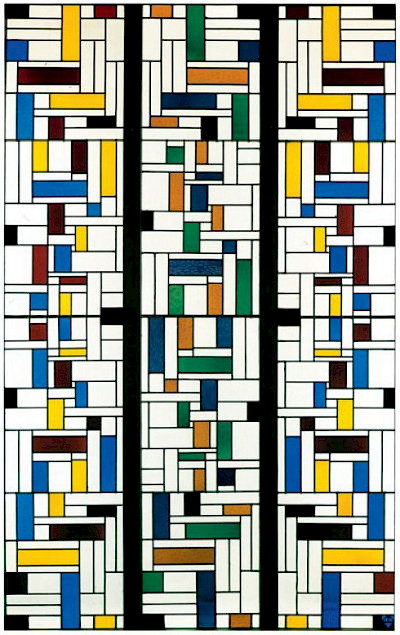
De Stijl group wanted to create a new kind of art, architecture and design in order to raise a disillusioned humanity from the horrors caused by World War 1 and as many artists throughout Europe, they attempted to liberate the arts from tradition. They wanted to change art from individual to ultimate, universal. Their vision was based on deconstructivism – reducing the universe to fundamental elements and forms – the vertical and horizontal lines became the symbols of universal harmony, to which were added primary colours red, blue and yellow along with black, white and gray (considered non-colours). Even if you don’t understand the deeper meaning of theosophy, these are the things you can recognize in artworks of De Stijl movement.
Anyways, members were aiming towards geometrical and technical art which would be an experience as a whole. They were trying to give art a spirit of forms and mystification.
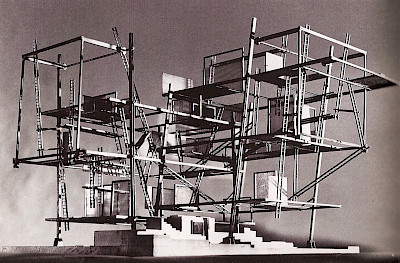
What was important for them was purity in architecture, the absence of organic and personal forms. Like theosophists, members of De Stijl believed in the presence of deeper spiritual reality, whereas a direct contact is established through a state transcending normal human consciousness. They brought a sense of material, intellectual and spiritual unity to art, architecture and design.
https://designblog.rietveldacademie.nl/?p=48321