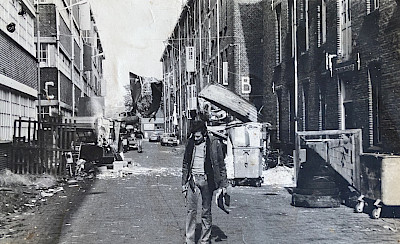
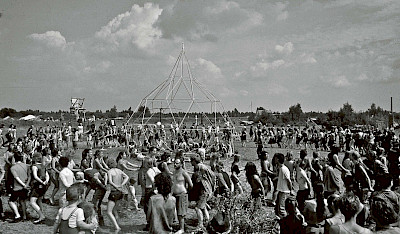
In the seventies and early eighties Amsterdam witnessed the growth of the so-called ‘kraakbeweging’ (squatter movement): a mixed group of mostly young people fighting for affordable housing for the less affluent and the creative. The term ‘kraken’ – a verb – was coined in this period to indicate the illegal squatting of unused, empty buildings. At the top of the movements’ strength, Amsterdam hosted between five and ten thousand ‘krakers’ divided over hundreds of empty buildings across the city’s central districts.
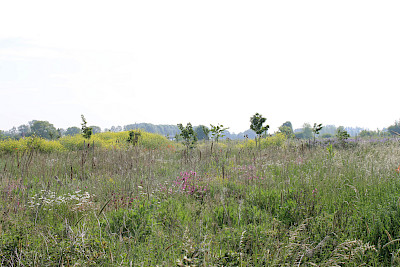
Whereas in the early years the ‘krakers’ main focus was housing, later it shifted toward a more diverse, social and cultural use of empty buildings. They provided room for a great variety of social and cultural initiatives to develop and in the process contributed to social cohesion in neighborhoods. Due to the increasing control of the municipality of Amsterdam over its property, the geographic scope of the movement widened in the nineties when ‘krakers’ took over major spaces - large buildings as well as land - in the port areas located on the southern banks of city river ‘het IJ’.
Historically, the role of the Amsterdam municipality regarding ‘krakers’ has been an ambiguous one. On the one hand, it was hostile as it often protected private ownership in times of housing shortages and provided police support for evictions. On the other hand, ‘krakers’ cultural and social initiatives regularly received municipal funding and the movement depended on the city government for purchasing or renovating some of their beloved buildings.
However, the lack of recognition for the added value of communities managing space has been a common thread throughout commons history which resulted (and still results) from municipal policy that is mainly profit-driven and focuses on quantification, standard output measuring and competition. Contrarily, the occupied spaces have proven to be extremely diverse, cooperative rather than competitive, and its results often unquantifiable and therefore difficult to measure uniformly.
Urban Commons Shared Spaces, Jens Kimmel, Till Gentzsch and Sophie Bloemen, Commons Network & Raumlaborberlin, 2018, p. 15.